Complex fund computations: deterministic at the core. Agentic at the edge.
How CapHive is helping private
market fund managers eliminate spreadsheet dependencies, institutionalise complex
financial logic, and build the foundation for AI-powered fund operations.
·7 min read·Fund accounting
The last mile of fund automation remains surprisingly manual
Private markets have grown significantly in scale, complexity and sophistication. Yet,
behind the scenes, some of the most critical financial computations continue to depend
on spreadsheets, manual adjustments and the institutional knowledge of a handful of
experienced fund accountants.
The challenge is not simply calculating management fees, carried interest, NAVs or
investor allocations. It is managing the extraordinary variety of rules, exceptions and
interdependencies that arise across funds, investors, share classes, currencies and
investment vehicles.
Consider a fund with multiple feeder vehicles, investor-specific side letters, different
fee arrangements, complex distribution waterfalls and investments denominated in
multiple currencies. A seemingly straightforward fee or carry calculation can involve
dozens of interdependent computations, each governed by specific contractual terms.
Traditional fund accounting systems often struggle with this complexity. The result is a
familiar operating model: standard calculations happen in the system, while exceptions
and more complex logic are handled through Excel, manual overrides and offline
reconciliations.
The most complex and consequential computations are often the least automated, least transparent and most dependent on individuals.
At CapHive, we believe that
genuine fund automation requires a different architectural approach.
Deterministic by design. Flexible by architecture
CapHive has been purpose-built
to automate highly complex fund computations, without sacrificing the flexibility that
private market structures demand.
At the heart of the platform is a powerful, configurable computation framework that
supports fund-specific algorithms, investor-level rules, multi-vehicle dependencies and
sophisticated allocation methodologies.
Unlike platforms that rely on a fixed library of standard calculations,
CapHive provides the
flexibility to model bespoke financial logic within the application itself. This
includes:
Fund-specific algorithms that accommodate complex commercial terms, investor classes and allocation rules.
03 · Structures
Multi-vehicle structures
Computations that span master funds, feeder funds, SPVs and other interconnected investment vehicles.
04 · Currency
Multi-currency operations
Currency conversions, exchange-rate movements and related adjustments.
05 · Investors
Investor-specific arrangements
Side letters, negotiated fees, expense limitations, excused investors and other exceptions that require individualised treatment.
06 · Shadow books
Shadow books
Information at your fingertips.
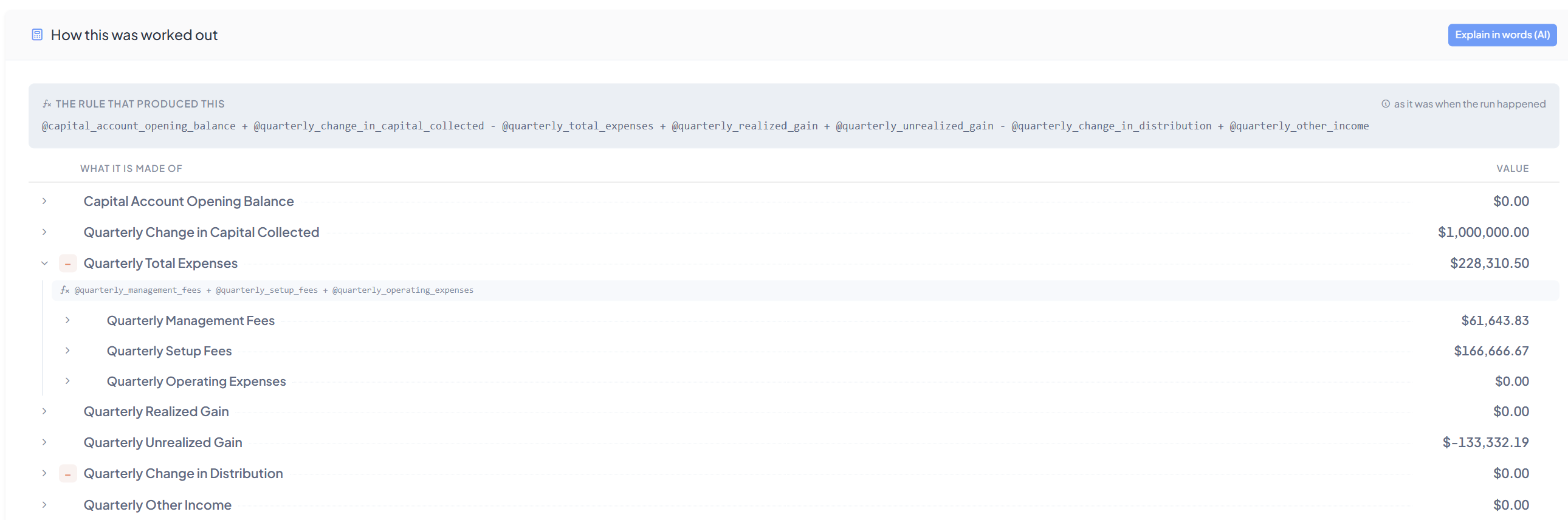
Same inputs, same numbersEvery figure explained to its inputsRules versioned with each runMaster before feeders, in orderNo spreadsheet overlays
Importantly, every financial computation is executed deterministically within
CapHive's application, not
generated probabilistically by an AI model.
Given the same inputs, rules and configuration, the application produces the same
results. Computations are supported by traceable calculation logic, explainable
allocations and audit trails.
Financial correctness cannot be a matter of probability.
Fund managers need confidence not only in the final number, but also in their ability
to explain exactly how that number was derived, without having to depend on
individuals.
EnlargeEvery computed number carries the rule that produced it, and the values that went in.
Case study: automating multi-vehicle, multi-currency computations for a multi-billion-dollar PE fund
A particularly compelling example comes from
CapHive's work with a
multi-billion-dollar private equity fund operating a complex master-feeder structure.
The fund had two feeder vehicles, including one denominated in a different currency,
investing through a master fund, and a related SPV.
The challenge
The structure created intricate computational dependencies. Management fees and carried
interest calculations at the master fund level needed to reference computations
originating in the feeder vehicles, while also accounting for exchange-rate movements
and related adjustments.
These were not independent calculations that could be processed in isolation. A change
in one vehicle could affect calculations in another, requiring careful coordination
across the entire structure.
The fund administrator's existing systems could not natively handle all these
interdependencies. Instead, the team relied on spreadsheets and multiple manual overlays
to reconcile results and arrive at the required figures. This introduced several
operational risks:
Manual intervention created opportunities for errors and inconsistencies and weakened auditability.
Reconciliations became more time-consuming and difficult to reproduce.
Knowledge of unusual scenarios and edge cases was concentrated among a small number of experienced individuals.
Changes to calculations required careful coordination across multiple spreadsheets and teams.
The issue was not a lack of accounting expertise. It was an operating architecture that
depended excessively on that expertise to compensate for technological limitations.
The CapHive approach
CapHive configured the
underlying fee, carry, allocation and currency-adjustment logic directly within its
deterministic computation framework.
Computations could reference results across the feeder and master vehicles, apply the
appropriate currency treatments and execute the required interdependent calculations
without manual spreadsheet overlays. The outcome was a fundamentally more resilient
operating model:
No manual calculation overlays: complex cross-vehicle calculations were automated within the platform.
Full traceability: calculation logic, intermediate results and allocations could be reviewed and explained.
Greater consistency: the same rules could be applied repeatedly, reducing reliance on individual interpretation.
Institutionalised knowledge: bespoke logic and edge cases were embedded in the platform rather than retained in individual spreadsheets.
Scalable operations: the fund gained a stronger foundation for managing growing transaction volumes and structural complexity without proportionately increasing manual effort.
The most important transformation was not simply faster computation.
It was the conversion of a fragile, person-dependent process into a repeatable, controlled and institutionalised operating capability.
Why AI should not be responsible for the final financial number
As AI capabilities advance, there is understandable enthusiasm about using large language
models and autonomous agents for fund accounting.
But there is an important distinction between using AI to assist with financial
processes and asking AI to independently determine financial results.
Large language models are probabilistic by nature. They are remarkably capable of
interpreting documents, understanding context, suggesting approaches and identifying
anomalies. But their outputs are not inherently deterministic, and they are not
substitutes for controlled financial calculation engines.
For fund managers and administrators, this distinction is critical. An incorrect
allocation, an overlooked side-letter provision or an inconsistent carry calculation can
create financial, regulatory and reputational consequences.
Our philosophy is simple: use deterministic engines for financial
computations, and AI agents for the intelligence, interpretation and workflow
automation surrounding them.
This separation allows fund managers to embrace AI without compromising the integrity of
core financial calculations.
It also provides a more practical approach to data security and governance. AI
capabilities can be introduced selectively, with appropriate data access restrictions,
human approvals and auditability, rather than granting an autonomous model unrestricted
access to sensitive investor and financial information.
The next frontier: AI agents as virtual fund operations employees
While core calculations remain deterministic, many of the activities surrounding fund
accounting still require substantial human effort.
These include interpreting LPAs and side letters, reconciling historical records,
identifying inconsistencies, preparing data for upload, investigating exceptions,
explaining unexpected movements and coordinating reviews. These are precisely the
activities where AI agents have the potential to create substantial value.
CapHive's architecture enables
clients to progressively introduce an optional AI and agentic layer around the core
application, without changing the deterministic nature of the underlying computations.
This operates at two levels: during initial set-up and configuration, and during ongoing
fund operations.
Deterministic — natively in the app
AI / agentic overlay
Set-up
Series and class settings: fees, hurdle, carry, opex limit — with LP-specific settings inside each commitment
Algorithms for computations, set up from existing Excel computations and the team's feedback on edge cases, and checked against the LPA and side letters
Pre- and post-checks
Review of the set-up against the LPA and side letters
Suggesting pre- and post-checks
Reconciliation of historical data
Ongoing
Accounting data pulled in through APIs or uploads (manual or agentic)
Formulas run
Click-through explanations
Receiving emails and converting them to upload format
AI assistant for reconciliation and explanation
Updates to the team on status and matters needing review
Deterministic by design. Flexible by architecture.
Over time, this creates the foundation for something more powerful: virtual fund
operations employees.
Rather than simply answering questions through a chatbot, specialised agents can execute
increasingly sophisticated, multi-step operational workflows, coordinating with the core
platform and escalating exceptions to human teams.
A reconciliation agent, for example, can be tasked with reviewing a quarter-end close,
identifying unexplained differences, tracing them to underlying transactions and
preparing a structured exception report.
These agents could become available on demand, scaling alongside fund operations rather
than being constrained by traditional staffing models.
The goal is not to eliminate the need for experienced fund accountants. It is to allow
their expertise to be applied where it matters most: judgment, oversight, exception
resolution and investor relationships, instead of repetitive data handling and manual
reconciliations.
Institutional memory: an overlooked benefit of automation
Complex funds accumulate institutional knowledge over many years. This includes how
unusual transactions are handled, why particular investors receive special treatment,
how historical exceptions were resolved and how sophisticated allocation methodologies
have evolved.
Much of this knowledge traditionally resides in spreadsheets, email correspondence and
the memories of a few senior fund accountants. When individuals leave or
responsibilities change, that knowledge can be difficult to recover.
By embedding financial logic, contractual configurations, calculation dependencies and
audit trails within the application,
CapHive helps preserve this
institutional memory.
AI agents can potentially make that knowledge even more accessible by helping teams
investigate historical decisions, understand computational logic and navigate
exceptions. This is particularly valuable for multi-fund managers, administrators and
other organisations managing increasingly complex structures across jurisdictions.
The long-term competitive advantage is not merely automation. It is building an
institutional knowledge base that becomes stronger, more accessible and more scalable
over time.
An AI-ready operating architecture
Not traditional software or AI. Both, combined well.
The future of fund operations will not be defined by choosing between traditional
software and AI. It will be defined by how intelligently the two are combined.
Financial computations demand precision, reproducibility and robust controls.
Operational workflows increasingly benefit from contextual reasoning, adaptability and
autonomous execution.
A deterministic, highly configurable financial computation engine at the core, complemented by an optional AI agentic layer that can progressively automate complex operational workflows.
Discover how CapHive can
automate your most complex fund computations and prepare your operations for an agentic
future.